⚡ In a Rush? The 30-Second Fix
- Come in late October or early November, not April. Same palaces, same temples, a fraction of the queue — and autumn is reliably Korea’s clearest season for air quality.
- The best single day trip from Seoul: Buseoksa in Yeongju. KTX-Eum from Cheongnyangni Station takes about 1 hour 40 minutes, then a 45-minute bus climbs the mountain. Entry is free, and in early November the sun drops behind the Sobaek ridges just after 5:20 p.m.
- Pack for two seasons in one day. Around 8°C at 8 a.m., 17–18°C at 2 p.m., single digits again by 7 p.m. A light down jacket over a T-shirt beats one heavy coat.
Part 1: The Spring vs. Autumn Myth (and Why Spring Quietly Loses)
Every guidebook, every tourist board poster and half the comments under any Korea travel video say the same thing: come in spring. Cherry blossoms, mild weather, the whole romantic package. I understand the appeal. I just don’t think spring is the season that gives you the best trip. For those who want clear skies, crisp mountain air, and dramatic temple scenery without the crushing crowds, late autumn is secretly the best time to visit Korea.
Here is what spring actually costs you. The cherry blossom is a five-to-nine-day event, and the entire country plans its year around it. Hotels in Seoul and Busan price those weeks as peak season, KTX seats sell out weeks ahead, and the famous spots — Yeouido’s blossom tunnel, Jinhae’s rail line, the palace courtyards — turn into shoulder-to-shoulder queues where nobody is looking at the flowers so much as the back of the person in front of them. If it rains once, or a warm spell pushes the bloom early, you miss it entirely. It is the most weather-dependent, most expensive, most crowded two weeks Korea has.
Spring also has a habit nobody mentions in the brochures: dust. March and April are peak season for fine particulate matter and the yellow dust that blows in from the north, and on the worst days the mountains you came to see turn into a gray smear fifty meters away. Flights get delayed, hikes get canceled, and a view that looked spectacular in a photo is simply not there.
Autumn is the reverse on almost every count. The color doesn’t arrive all at once as one fragile week; it rolls south over roughly six weeks, starting in the high mountains in early October and reaching the southern coast into mid-November. Miss the peak in Seoraksan and you can still catch it a week later in the center of the country, and another week after that in Jeolla. It gives you several chances instead of one, which is worth more than any single perfect photo.
The air is the part locals notice most. September to November consistently posts Korea’s cleanest readings of the year — the kind of deep, hard blue sky that makes a phone photo look edited. Evenings turn cool enough to enjoy the street food that is miserable to eat in July. And the crowds thin out: not empty, but half of spring’s at the same places, with hotel rooms you can usually book for noticeably less than blossom week.
Autumn has real downsides, and you should plan around them. Days get short fast — by early November sunset in Seoul is around 5:25 p.m., and at a mountain temple you will be walking down in near-dark if you stay for it. Some high trails close for winter from mid-November. And late October weekends at the marquee spots (Naejangsan, the Seoul palaces) are now genuinely busy, because Koreans have decided autumn is the season too. Weekdays fix almost all of that.
Part 2: Golden Ginkgo Carpets & Ancient Wooden Architecture
If I could only send a visitor to one place in autumn, it would not be a mountain. It would be Buseoksa, a temple on the shoulder of Bonghwangsan in Yeongju, North Gyeongsang Province, about two hours from Seoul by train and bus. Founded in 676, one of the seven Korean mountain monasteries inscribed by UNESCO in 2018, and — unusually for a site this significant — completely free to enter, with no booking.
You arrive at the bottom and walk. From the Iljumun gate a ginkgo-lined path runs about 800 meters up to the Cheonwangmun gate, and in the last week of October and the first days of November those trees drop a yellow carpet that is thick enough to muffle your steps. Then come the stone stairs, the terraces, and finally Muryangsujeon, the main hall, holding its ground on a stone platform above the whole complex. The building is a designated National Treasure and one of the oldest wooden structures in Korea, rebuilt in 1376 during the late Goryeo Dynasty after being damaged during fourteenth-century pirate incursions; the columns are carved with entasis, a deliberate convex swelling in the middle that makes wood behave like muscle. Stand in front of them for a minute and the age of the thing lands on you.
Then stay for the light. This is the actual reason to come in November rather than in summer: the sun sets behind the Sobaek ridges directly west of the upper courtyard, and for about twenty minutes the whole hillside turns the color of the ginkgo leaves. Nobody organizes this. There are no queues. People simply go quiet and sit on the stone edge, and then, quite quickly, the temple empties and the cold comes up out of the valley.
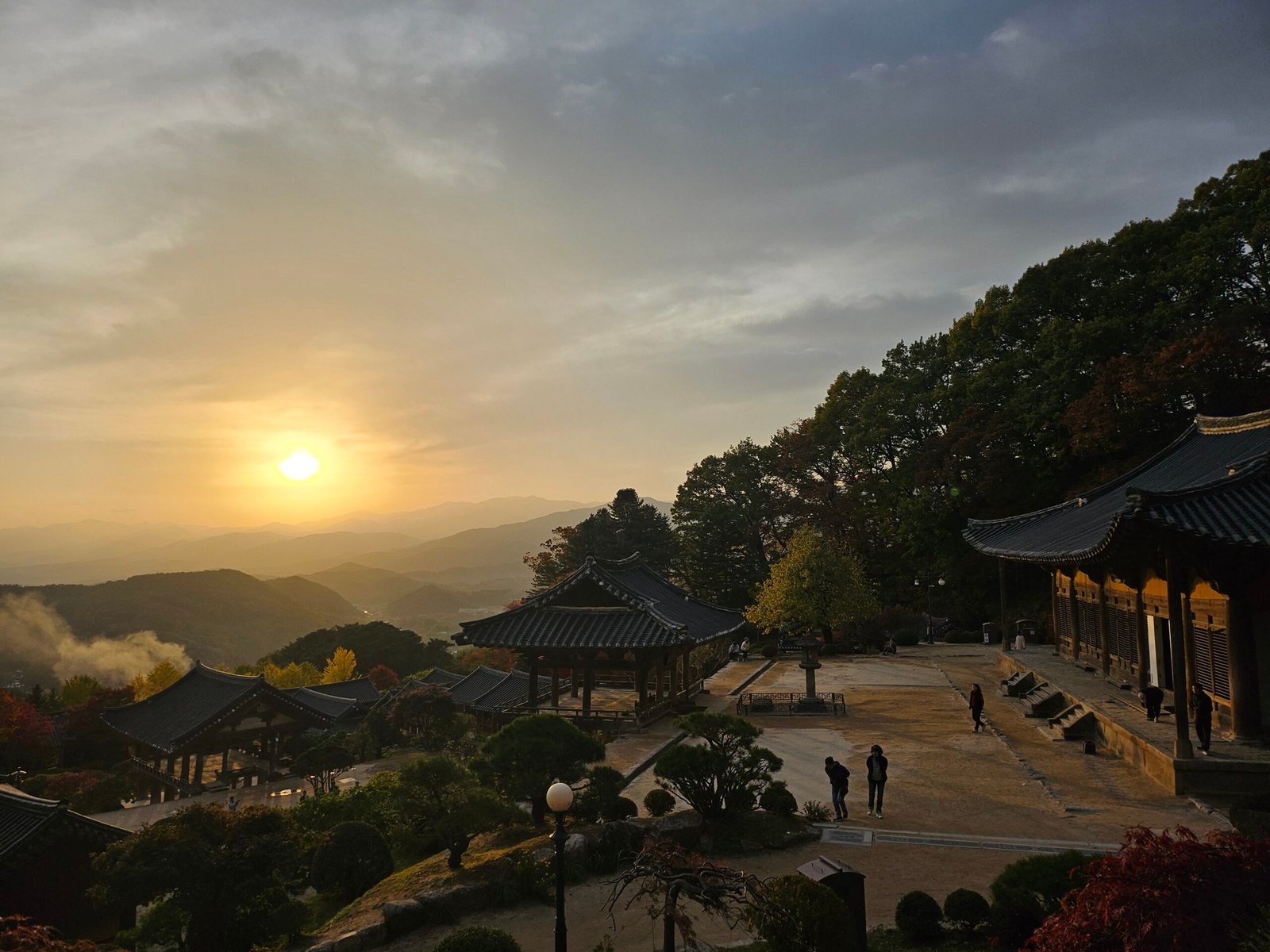
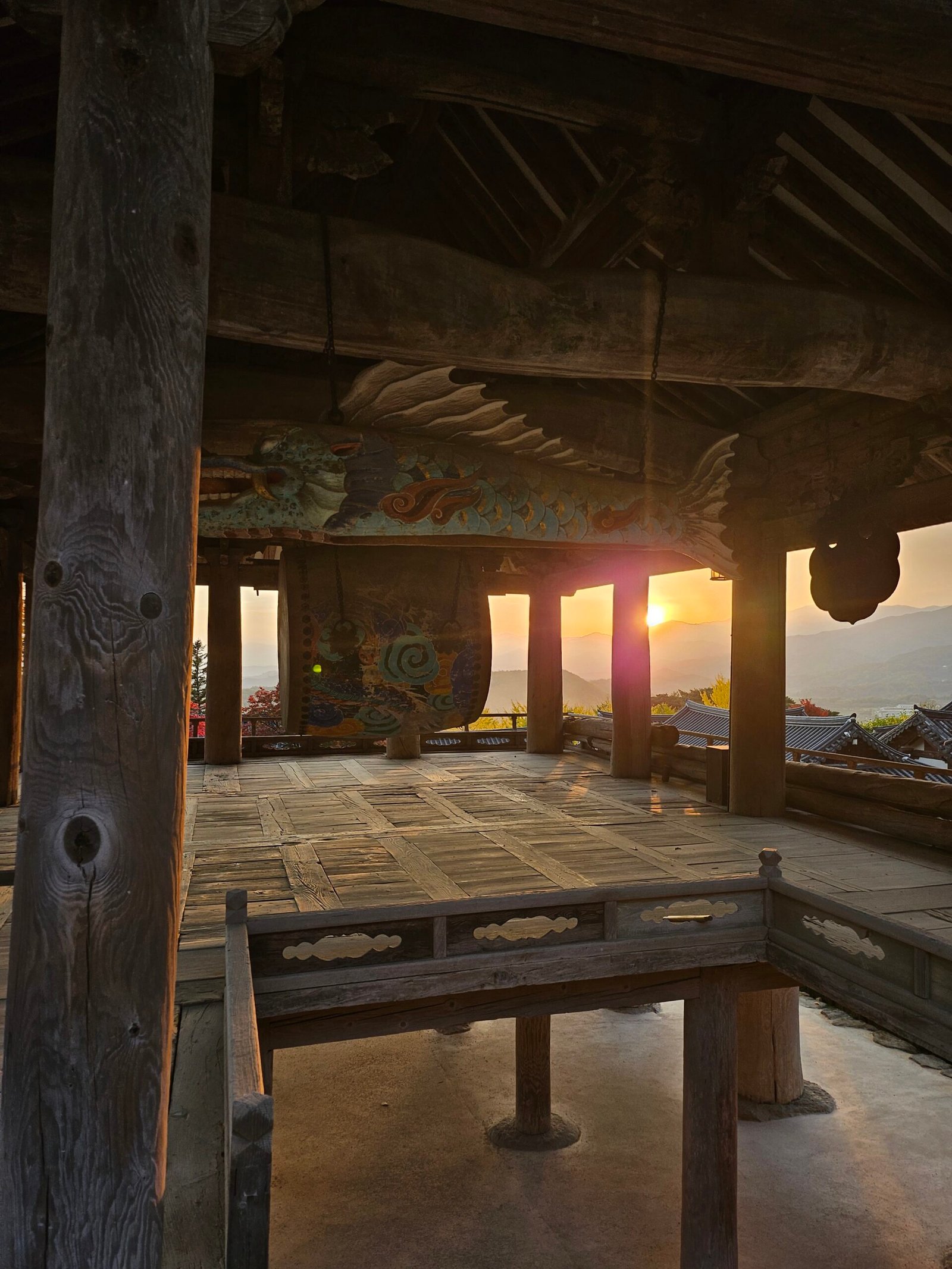
The second thing worth slowing down for is the woodwork. Korean temple architecture saves its best carving for the parts you have to look up at: the bracket sets under the eaves, the painted beams, the instruments hanging in the gate pavilions. At Anyangnu, the gate that opens onto the Muryangsujeon courtyard, a huge carved wooden fish and a painted dharma drum hang in the shadow of the roof; late in the afternoon the sun comes straight through the open bays behind them and burns an orange line across the grain of the beams. It is a two-minute photograph and a twenty-minute thing to stand in.
Practical notes, because this is where most foreign visitors get caught out. The temple is open year-round and admission is free. However, winter hours take effect from November through February (09:00 to 17:00), with last entry strictly cut off at 16:00 (4:00 p.m.). Because the scenic walk up from the bus stop and lower parking lot takes 30 to 40 minutes, you must pass the ticket gate well before 4:00 p.m. to be settled in the upper courtyard for the 5:15–5:20 p.m. sunset. From Yeongju Intercity Bus Terminal, city buses 27 and 55 run up to the temple (roughly hourly, about 45–70 minutes depending on the route); the last one back leaves in the early evening, so check the timetable at the terminal before you go up rather than at the top. There is a weekend express, bus 28, that stops at Yeongju Station itself. The walk from the lower parking lot to Muryangsujeon takes around 40 minutes at a gentle pace including stairs — this is not a flat temple, and there is no shortcut for tired legs beyond the upper parking lot. Bring a flashlight for the descent if you stay for sunset, and shoes with grip, because the stone steps are polished smooth by thirteen centuries of feet and get slick after rain.
Part 3: Hidden Autumn River Escapes (Just 90 Minutes from Seoul)
Everyone goes to the mountains for foliage. The rivers are where autumn is quiet, and three of the best are close enough to Seoul for a day trip.
Danyang: three rocks in the middle of the Namhan River
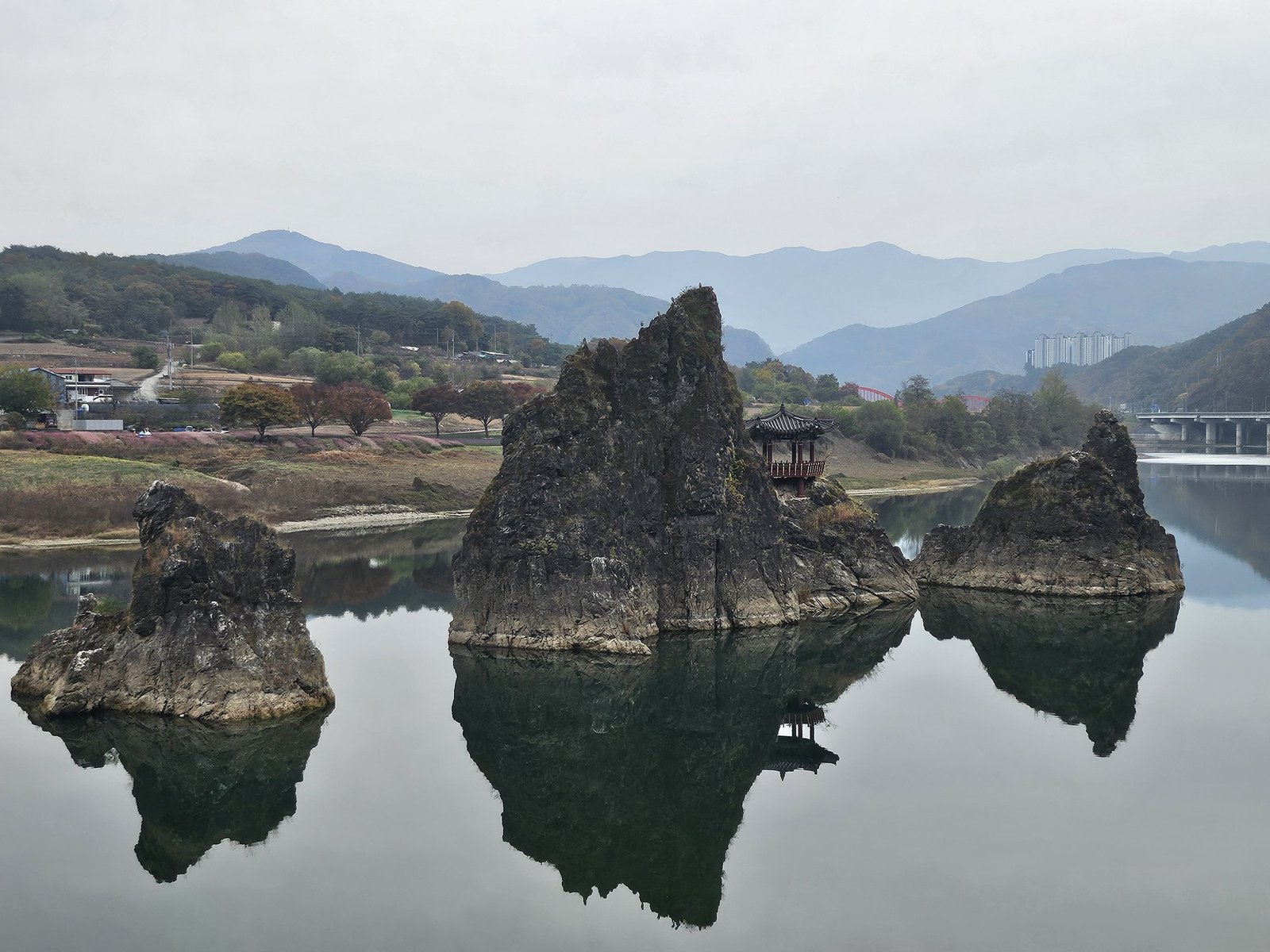
Danyang is a small town in Chungcheongbuk Province where the Namhan River slows down and widens, and in the middle of it stand three limestone pinnacles known as Dodamsambong — the first of the eight scenic views of Danyang, and a designated scenic site. The tallest is associated with Jeong Do-jeon, the fourteenth-century statesman; the middle one with his wife, the smallest with his concubine, which is the kind of story Korean tour guides tell with visible relish. You can look at them from the bank in ten minutes, or take a small boat out for a closer, lower angle that makes the scale land properly.
Behind the parking lot, a steep staircase climbs for about ten minutes to Seokmun, a natural stone arch that frames the river and the town beyond it. It is the better photograph and most visitors skip it. From Cheongnyangni, KTX-Eum reaches Danyang in around 1 hour 15 to 20 minutes; from Danyang Station it is a 10–15 minute taxi or local bus to the rocks. Add the riverside walk or the cable car over the town if you have a full day, and eat lunch in the market before you leave.
Yeoncheon: the flaming crimson sea of kochia on the Imjingang River flats
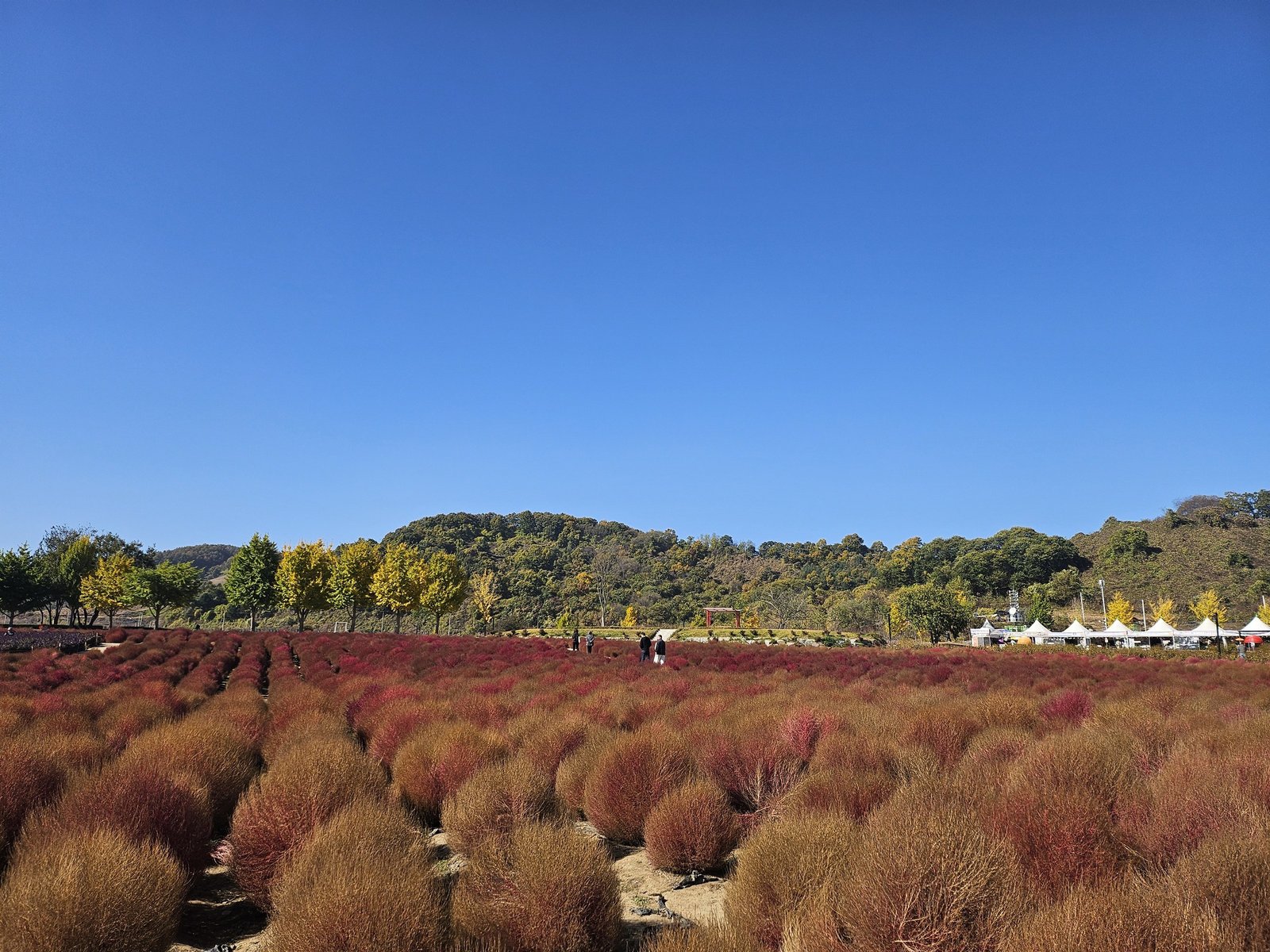
If you want vivid autumn colors without climbing a single mountain, Yeoncheon is the country’s best-kept autumn secret. Along the flats of the Imjingang River in Samgot-ri, just south of the DMZ border, hundreds of thousands of round Kochia scoparia bushes (known in Korea as daebssari) turn from bright lime-green in summer to a blazing, deep magenta-ruby in late October and November. Interspersed with fields of purple asters, yellow zinnias, and silver grass, the entire riverbank looks like an impressionist painting laid across the valley floor.
The garden is completely flat and free to enter, making it a delightfully relaxed contrast to the crowded, steep paths of famous national parks. Wooden walkways weave through the waist-high red mounds, leading towards a solitary pine tree that overlooks the winding Imjingang River. On a crisp autumn morning under a cloudless cobalt sky, the saturated crimson against the golden ginkgo trees and distant DMZ ridgelines is one of the most striking visual spectacles in Gyeonggi Province. Because it sits in the northern border county, the air is extraordinarily clean and the light stays sharp all afternoon.
Getting there from central Seoul has become remarkably straightforward since the northern extension of Seoul Subway Line 1 opened up to Yeoncheon Station. From Yeoncheon Station, a local bus or a quick 10-to-12-minute taxi ride (around 12,000–14,000 won) takes you directly to the Samgot-ri entrance. Pair it with a bowl of warm local noodle soup or braised tofu in Yeoncheon town before heading back.
Pocheon: walking 50 meters above the volcanic canyon on Hantangang Sky Bridge
Just east of Yeoncheon along the same ancient volcanic fault line lies Pocheon’s Hantangang river valley. Hundreds of thousands of years ago, basalt lava poured down this basin from volcanic eruptions near Pyeonggang, cooling into dramatic hexagonal columns that the river has spent millennia slicing into a steep canyon. Rather than an arduous cliff hike, the most effortless and panoramic way to take in this geological wonder in autumn is the Pocheon Hantangang Sky Bridge.
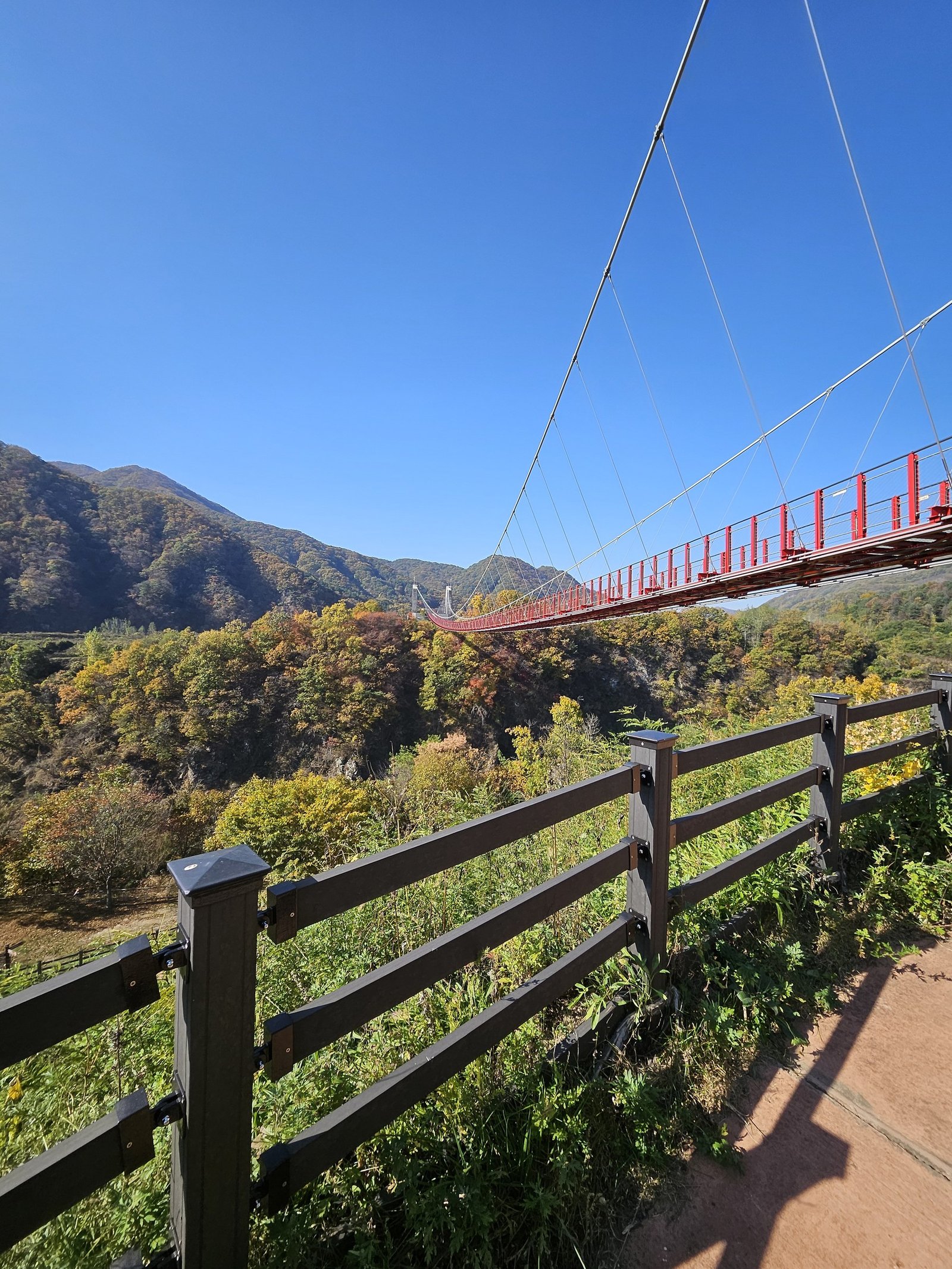
Opened as a pedestrian-only suspension bridge, this 200-meter scarlet bridge floats roughly 50 meters directly above the gorge floor. As you walk across the timber and mesh deck, the entire basalt canyon opens up beneath you: emerald-tinted rapids rushing over rock flats, flanked on both canyon walls by dense foliage of russet oak, fiery sumac, and amber maples. Transparent tempered glass viewing panels in the center section allow you to look straight down into the chasm without getting your boots muddy.
Admission and parking are both free, and the bridge connects smoothly to gentle walking paths heading towards the famous Bidulginang Cascade — a basalt grotto waterfall carved out of the volcanic rock face that has featured in dozens of Korean historical dramas. From Seoul, express buses run from Dong Seoul or Gangnam to Pocheon, or you can drive up via the Sejong-Pocheon Expressway in about 70–80 minutes outside weekend rush hours.
Part 4: Autumn Comfort Food — What Locals Eat When the Evening Chills Arrive
Korean food changes with the temperature in a way that surprises visitors. Summer food is cold noodles and raw fish; by late October the tables turn to things that arrive bubbling.
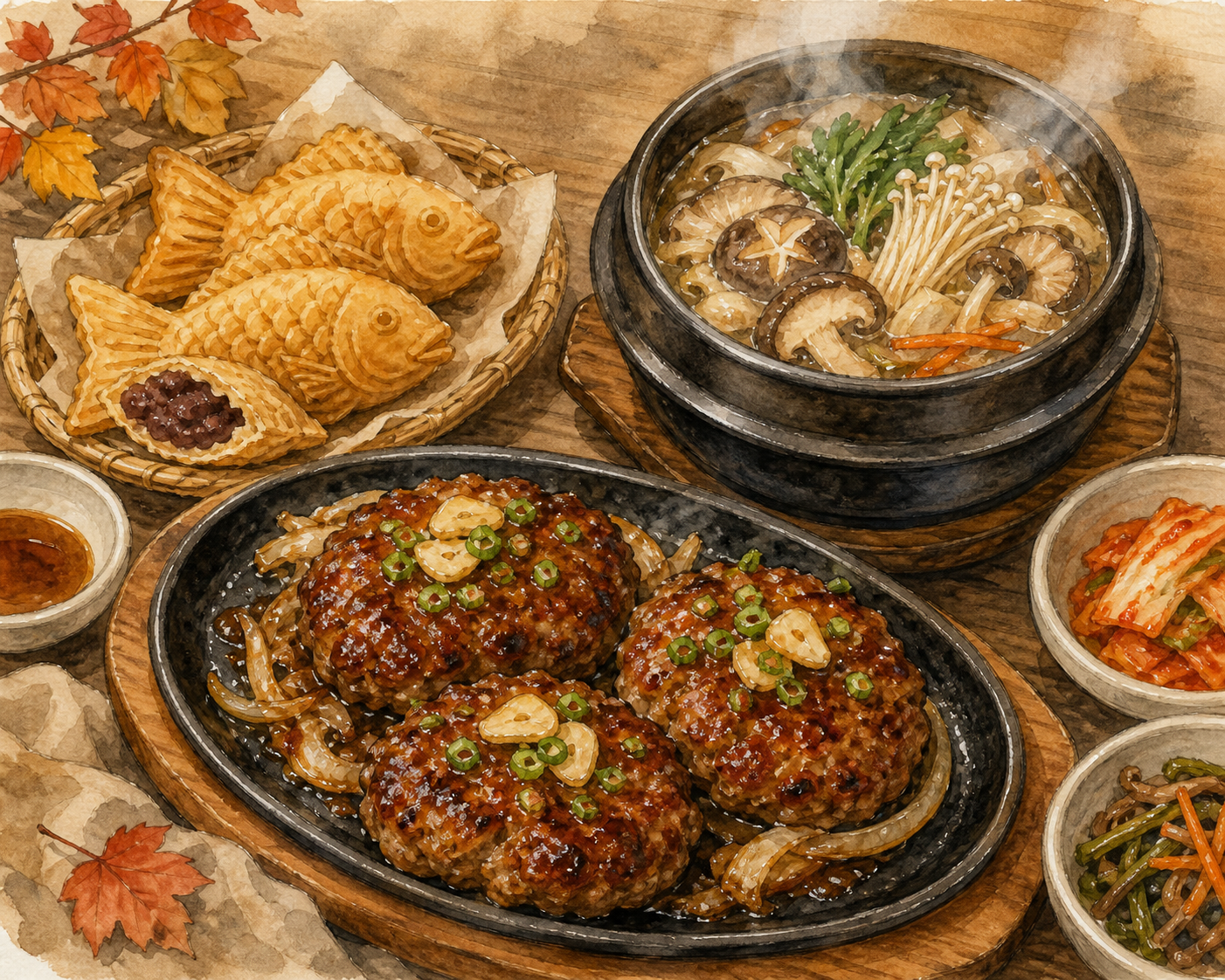
Danyang garlic tteokgalbi. Danyang garlic is a local point of pride, and the town’s signature dish is a patty of minced beef and pork bound with it, grilled over the table and eaten wrapped in lettuce with a slice of raw garlic. It is sweeter and less salty than the Seoul version, and it is the correct lunch after a morning on the river. Expect somewhere in the region of 13,000–18,000 won per person for a set; the side dishes come free and get refilled.
Mushroom hot pot. Around Sobaeksan and the inland mountains, autumn is mushroom season, and restaurants serve a beoseot jeongol — a shallow pot of several kinds of mushroom, vegetables, and either beef or a clear anchovy broth, brought to the table raw and cooked in front of you. It is the least spicy, most savory thing on any Korean menu, which makes it the safe order for anyone worried about heat. One pot feeds two for about 25,000–35,000 won.
Street food, eaten standing up. Once the sun is down, the practical local snack is a paper cone of roasted sweet potato, sold from drums on street corners and in front of subway exits from October onwards, hot enough to burn your fingers. Then bungeoppang: a fish-shaped batter cake filled with sweet red bean paste, four for a few thousand won, pressed in rows on a griddle that steams the whole street. Neither is a meal. Both are what the walk home tastes like in November, and neither costs enough to think about.
Part 5: Practical Autumn Foliage Cheat Sheet
Peak foliage moves south at roughly 20–30 km a day, and the exact dates shift by a week or more each year depending on summer heat and the first cold snap. Treat the table below as the usual window, then confirm with the Korea Forest Service’s foliage map or the weather service forecast the week you fly.
| Region | Where to go | Usual peak | What it is actually like |
|---|---|---|---|
| Gangwon, northeast | Seoraksan, Odaesan | early–mid Oct | First color in the country; cable car queues, so start at dawn |
| Central inland | Sobaeksan, Chiaksan, Danyang | mid–late Oct | Best balance of color and space; rivers and gorges at their clearest |
| Seoul and Gyeonggi | Palaces, Bukhansan, Nami Island | late Oct–early Nov | Ginkgo first, then maple; weekday mornings are almost empty |
| Gyeongsang | Buseoksa, Gyeongju, Juwangsan | late Oct–early Nov | Temple + ginkgo + sunset; the 800 m ginkgo path is the highlight |
| Jeolla and south coast | Naejangsan, Jiri, Boseong | early–mid Nov | Latest and most saturated red; Naejangsan is packed at weekends |
| Jeju | Hallasan, Jeju’s oreum trails | mid–late Nov | Silver grass on the oreums; wind and rain are the wildcard |
And the transport comparison, which is what actually decides a day trip. Three of these start at Cheongnyangni Station; Yeoncheon is a direct ride on Seoul Subway Line 1, and Pocheon is an intercity bus from Dong Seoul Terminal.
| Destination | From Seoul | Time | Fare (one way) | Last leg |
|---|---|---|---|---|
| Yeongju (Buseoksa) | KTX-Eum, Cheongnyangni → Yeongju | 1 h 37 – 1 h 49 | about 23,300 won | Bus 55 or 27, 45–70 min, roughly hourly |
| Danyang (Dodamsambong) | KTX-Eum, Cheongnyangni → Danyang | 1 h 12 – 1 h 22 | about 18,300–18,600 won | Taxi 8–10 min (about 8,000 won) or bus 15 min |
| Yeoncheon (Imjingang Kochia Garden) | Seoul Subway Line 1 to Yeoncheon Station | 1 h 30 – 1 h 40 | about 2,500 won (subway fare) | Local bus or taxi (10–12 min, ~13,000 won) to Samgot-ri entrance |
| Pocheon (Hantangang Sky Bridge) | Intercity bus, Dong Seoul → Uncheon | 1 h 15 – 1 h 25 | about 9,800 won | Local bus 62-1 or 15-min taxi to Bidulginang / Sky Bridge |
Fares and times checked in November 2026. KTX-Eum runs about nine or ten times a day on each route with limited seating, so on a Friday or weekend book a few days ahead on the Korail app or letskorail.com. City bus times in rural counties change with the season.
The Honest Conclusion
Spring in Korea is beautiful and everybody knows it, which is exactly the problem. Autumn is just as beautiful, lasts six times as long, costs less, and hands you sunsets that spring never quite manages. The catch is that it is shorter in daylight and colder at the edges, and that the best of it is not in Seoul — it is two hours out, at a temple on a mountain or a walkway inside a river gorge, where you have to plan one bus and get up early.
Do that once and you will stop asking when to come to Korea. Late October, a train from Cheongnyangni, and a jacket you can take off at lunch is the whole answer.
If you are already planning the trip, the one thing worth sorting out before you land is navigation: Google Maps does not do walking or driving directions in Korea, and half of the good places are missing from it entirely. I wrote a full step-by-step guide to using Naver Map in English, including how to read Korean addresses and share a pin with a taxi driver — How to Navigate Seoul Without Google Maps: The Complete Naver Map English Guide (2026).
Photographs in this post were taken in Korea between 27 October and 4 November 2026 on a Samsung Galaxy Z Flip5: Pocheon and Yeoncheon on 27 October, Buseoksa on 3 November, Dodamsambong on 4 November. The food illustration is a watercolor study.